Fadroma: Smart Contract Development Framework
Open-source framework for smart contract development that distills years of production deployment experience into reusable tooling for the CosmWasm ecosystem.
The Challenge
After years of building production smart contracts across multiple blockchain platforms, we kept encountering the same friction points:
Repetitive Boilerplate: Every new project required writing the same initialization logic, access control patterns, and deployment scripts. Senior engineers were spending time on solved problems instead of novel features.
Testing Complexity: Smart contract testing requires simulating blockchain state, handling async operations, and managing test fixtures. Each project reinvented testing infrastructure with varying quality.
Deployment Chaos: Moving from local development to testnet to mainnet involved manual steps, environment-specific configurations, and opportunities for costly mistakes. We'd seen projects deploy with wrong addresses or miss critical initialization steps.
Knowledge Silos: Patterns that worked well in one project didn't automatically transfer to the next. Lessons learned from security incidents or gas optimizations lived in individual codebases rather than shared infrastructure.
Multi-Chain Reality: Our work spans Secret Network, other Cosmos chains, and occasionally Ethereum. Each ecosystem had different tooling with different maturity levels. Engineers context-switching between chains lost productivity to tooling differences.
This wasn't just our problem - every team building on CosmWasm faced similar challenges. The ecosystem needed better shared infrastructure.
"It's truly a great experience to work with such a committed and professional team. Key tools like Undexer and Fadroma have been and are being used by other developers and builders nowadays."
- Daniel, Mandragora Validators
Our Approach
We built Fadroma to be the framework we wished we'd had from day one- distilling years of production experience into reusable, well-tested components.
Philosophy: Blockchain as Compute Substrate
Rather than treating blockchain development as fundamentally different from traditional software engineering, Fadroma embraces familiar patterns:
- Configuration over convention: Explicit configuration beats magic
- Composition over inheritance: Small, focused components combine flexibly
- Testing as first-class: If it's not tested, it doesn't work
- Documentation as code: Examples and docs live alongside implementation
Build vs. Use Decision
We evaluated existing tools before building:
| Tool | Strengths | Gaps for Our Needs |
|---|---|---|
| CosmWasm template | Official, minimal | No deployment tooling, basic testing |
| cw-plus | Battle-tested contracts | Library, not framework |
| Terrain (Terra) | Good DX | Terra-specific |
| Hardhat (EVM) | Excellent model | Wrong ecosystem |
Nothing provided the full development lifecycle support we needed, so we built it.
Open Source from Day One
Fadroma isn't a proprietary advantage - it's ecosystem infrastructure. Open sourcing means:
- Community contributions improve everyone's tools
- Security review from more eyes
- Adoption validates our approach
The Solution
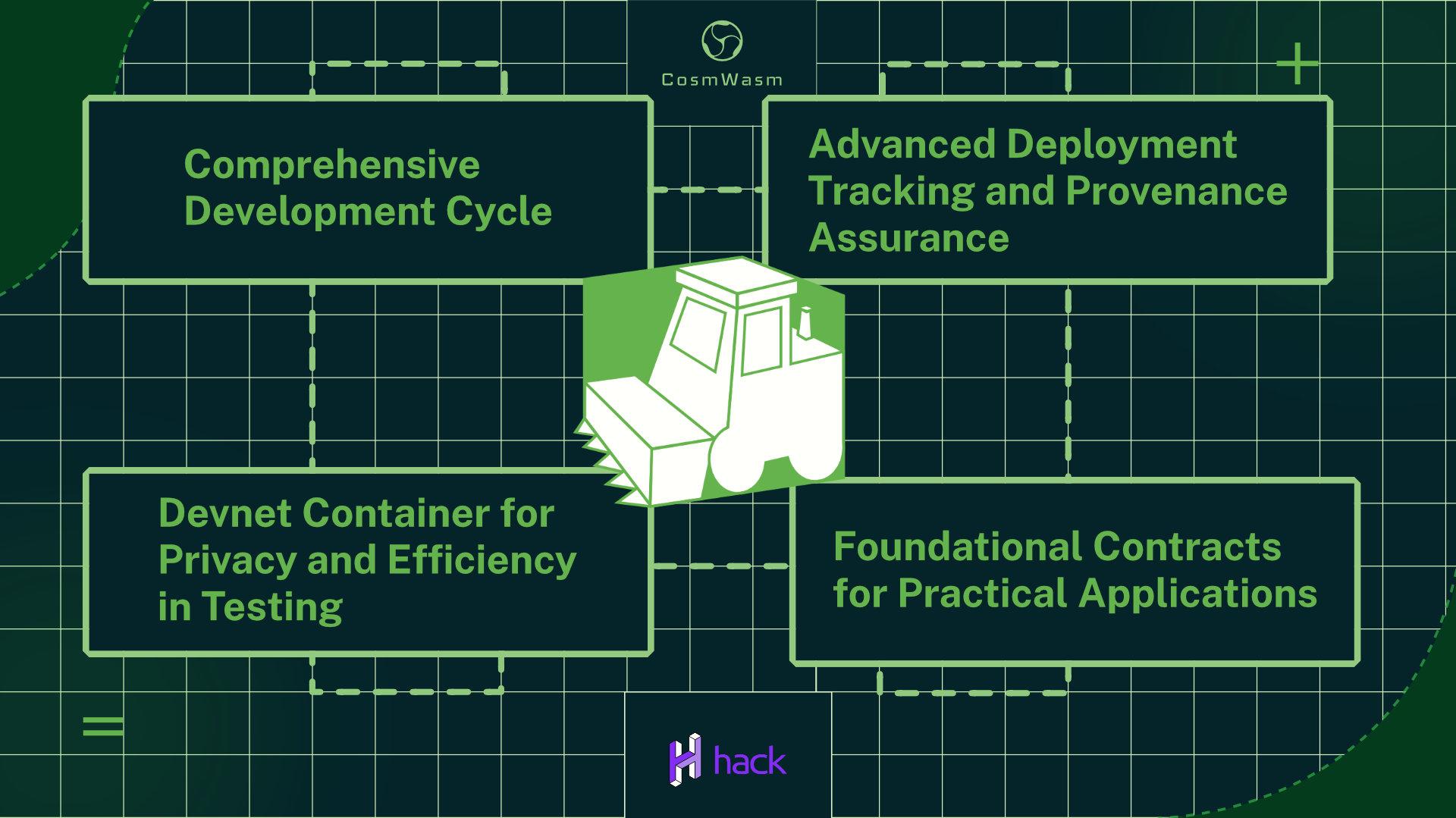
Fadroma provides a complete development lifecycle for CosmWasm smart contracts, from initial scaffolding through mainnet deployment.
Core Components
Project Scaffolding
# Create new project with sensible defaults
fadroma new my-project

# Add a new contract to existing project
fadroma add my-contract
Generated projects include:
- Cargo workspace configuration
- Contract boilerplate with common patterns
- Test infrastructure
- Deployment configuration
- CI/CD templates
Smart Contract Utilities
Building blocks for common patterns:
- Admin Module: Role-based access control
- Killswitch: Emergency pause functionality
- Migration Support: Safe upgrade patterns
- Storage Helpers: Type-safe state management
Testing Framework
#[fadroma::test]
fn test_initialization() {
    let mut suite = TestSuite::new();
    let contract = suite.deploy::<MyContract>();

    assert_eq!(contract.query_state(), expected_state);
}
Features:
- Mock blockchain environment
- Multi-contract integration tests
- Gas consumption tracking
- Snapshot/restore for complex scenarios
Deployment Pipeline
# Deploy to testnet
fadroma deploy --network testnet

# Promote to mainnet with same artifacts
fadroma deploy --network mainnet --verify
Capabilities:
- Environment-specific configuration
- Deterministic builds for verification
- Transaction batching for complex deployments
- Rollback support for failed deployments
Multi-Chain Support
Fadroma abstracts chain-specific details:
- Secret Network (primary target)
- Other CosmWasm chains (Cosmos Hub, Osmosis, etc.)
- Consistent API across chains
- Chain-specific optimizations where needed
Architecture Principles
Modular Design
Fadroma components can be used independently:
fadroma-core      -> Base utilities (usable standalone)
fadroma-testing   -> Test framework (usable with any contracts)
fadroma-deploy    -> Deployment tools (usable with manual contracts)
fadroma-cli       -> Full framework experience
Type Safety
Rust's type system catches errors at compile time:
- Contract addresses typed by contract
- Message types enforced at boundaries
- State access with compile-time key validation
Documentation Integration
- Inline examples that compile and test
- Generated API documentation
- Tutorial-style guides for common patterns
Evolution Over Time
Fadroma isn't a one-time release - it evolves with our experience:
Each major project we complete feeds improvements back into Fadroma.
Results
Internal Impact
| Metric | Before Fadroma | After Fadroma |
|---|---|---|
| Project setup time | 2-3 days | 2-3 hours |
| Testing coverage | Variable | Consistently high |
| Deployment errors | Occasional | Near zero |
| Knowledge transfer | Project-specific | Framework-based |
Ecosystem Adoption
Fadroma is used beyond Hack.bg:
- Sienna Network: Core development framework
- Independent Developers: Discovered via documentation and community
- Validators: Infrastructure tooling built on Fadroma patterns
"Key tools like Undexer and Fadroma have been and are being used by other developers and builders nowadays."
- Daniel, Mandragora Validators
Open Source Health
- Active GitHub repository with external contributors
- Documentation site with tutorials and API reference
- Discord community for questions and discussion
Continuous Improvement
Every client project provides feedback that improves Fadroma:
- Sienna Swap/Lend -> Privacy-preserving patterns
- Namada tooling -> Multi-chain abstractions
- Cosmos -> cosmos ecosystem compatible contracts
- Solana -> framework for solana programs
- Liquid network -> Simplicity support
Technologies Used
Rust CosmWasm Secret Network Cosmos SDK TypeScript Node.js GitHub Actions
Repository: github.com/hackbg/fadroma
Documentation: Available in repository
Website: fadroma.tech
Ready to ship your blockchain project?
From smart contracts to full-stack dApps, we turn your Web3 vision into reality. Let's talk about what you're building.
hello@hack.bg