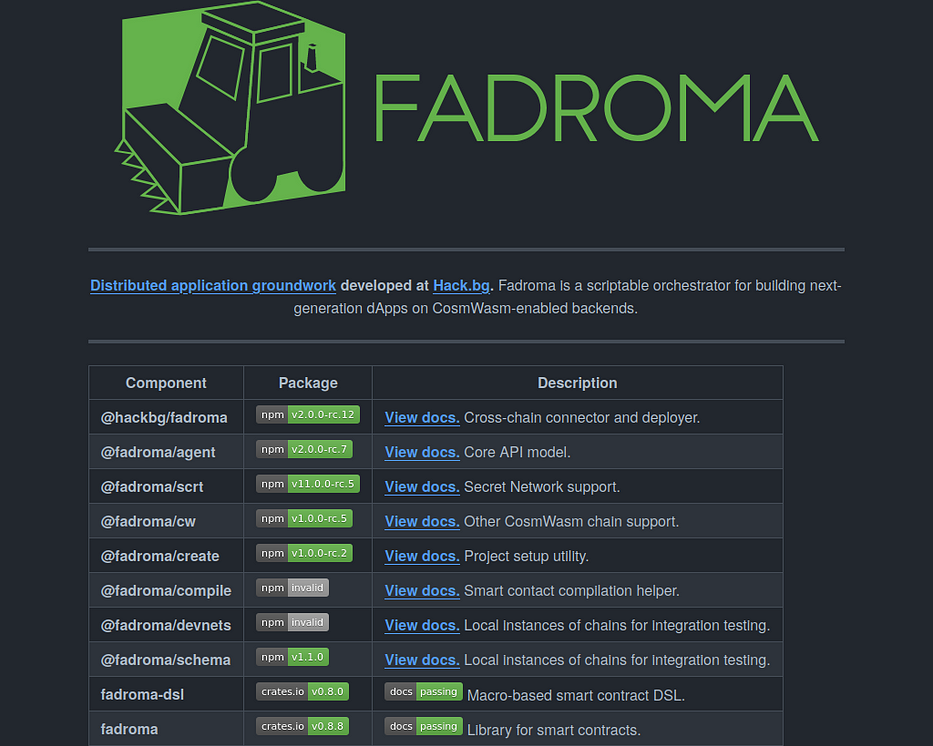
Since HackWasm 2023, we’ve been working on bringing version 1.0 of @fadroma/cw 1.0 to the wider CosmWasm community.
- During the hackathon, we confirmed the need for a general purpose CosmWasm client module in Fadroma.
- On September 30, powered by the OKP4 Nemeton Builders Program, we released
@fadroma/cw 0.6.0— the first beta of our support package for CosmWasm-enabled chains other than Secret Network. - Today, we’re pleased to announce pre-release versions of the packages constituting Fadroma 2.0 with native support for all CosmWasm-chains — starting from OKP4.

Released packages
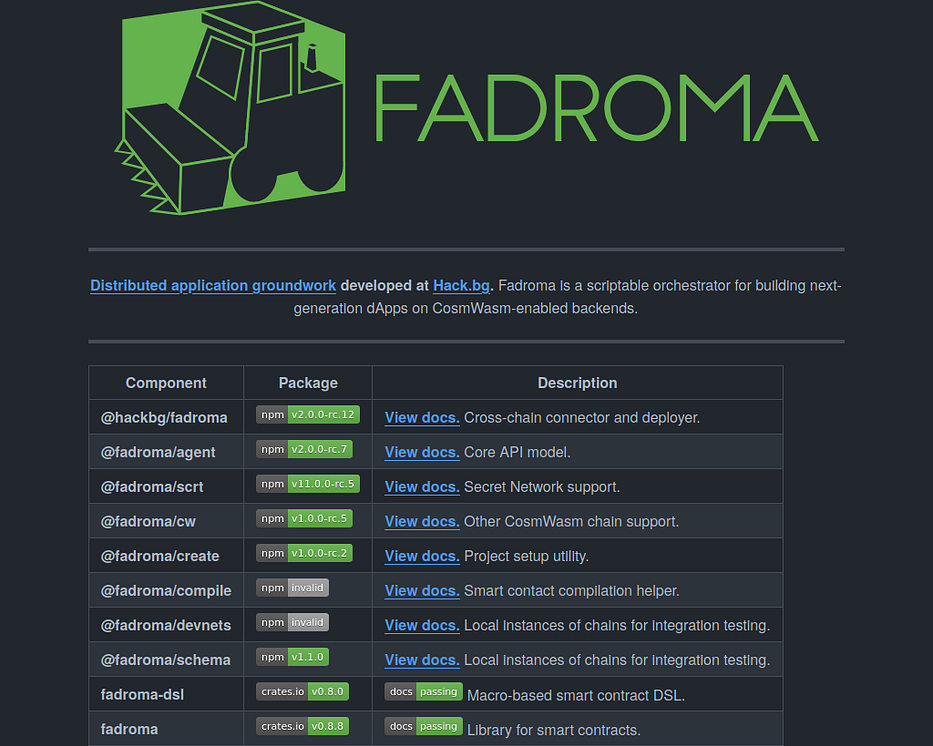
We have published the following release candidate builds:
@fadroma/agent 2.0.0-rc.7(NPM, GitHub)
The second generation of the unified Agent API.@fadroma/cw 1.0.0-rc.5(NPM, GitHub)
Implementation of Fadroma Agent API with CosmJS stargate. Adds support for CosmWasm-enabled chains other than Secret Network.@fadroma/scrt 11.0.0-rc.5(NPM, GitHub)
Brings the latest features of the Fadroma Agent API v2 to our long-standing support for Secret Network. (Not a typo — really goes to 11!)@hackbg/fadroma 2.0.0-rc.12(NPM, GitHub)
The new version of our main package has shed some weight! The following service packages are now published separately, reducing the coupling between client functionality and deploy services.@fadroma/create 1.0.0-rc.2(NPM, GitHub)
The project setup tool is now versioned separately.
Packages to be released
Expect stable (non-rc) versions of the above, plus:
@fadroma/compile(GitHub)
This package provides a containerized Rust compiler, and exposes a CLI for compiling smart contracts in an isolated, target-appropriate environment.@fadroma/devnets(GitHub)
This package provides containerized nodes of Secret Network 1.2–1.9 and OKP4 5.0 for integration testing and local development, and exposes a CLI for managing them.
Deprecation notice
The following package has been deprecated:
@fadroma/connect
With the native services being split off into as separate packages, the role of “client-side hub package” (which@fadroma/connectpreviously fulfilled) is now taken up by@hackbg/fadroma. The@fadroma/connectpackage will therefore be deprecated.
And more goodies
The Hack.bg Toolbox repository contains a host of various small general purpose support libraries that make Fadroma possible. Some of the packages that were upgraded during this release cycle include:
@hackbg/ensuite 1.5.3(NPM, GitHub), a tiny, no-nonsense alternative to Jest for modern asynchronous JavaScript, allowing for coverage reporting (withc8), JIT TS execution (with@hackbg/ganesha), and selection of test suite/case.@hackbg/ubik 2.0.8(NPM, GitHub), ourrecast-based AST multitool, which makes it possibe to publish well-formed, ESM-compatible NPM packages from TypeScript — such as@hackbg/secretjs-esmand@hackbg/cosmjs-esm.

This is just the beginning
This post is just a preliminary heads-up to let you begin to get hyped! As we stabilize Fadroma 2.0, prepare for a full release announcement detailing what has changed and how to get started with the new, multi-chain Fadroma!
In the meantime, you can follow the progress on v2.0 stable at this GitHub pull request.
Stay tuned!
???? ???? ????